

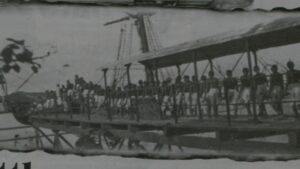
We all were shipped out from India – an India that had been pillaged and looted (a Hindi word, not so coincidentally!) Its native cottage industries – especially in textiles – were destroyed to create millions of peasants as “surplus labour” that sought a vent. We were othered into “coolies” – persons suitable for providing menial labour at the bottom of the social ladder. But in an era of asserted enlightenment, they were subject to an “agreement” on the conditions of their labour. It is this agreement – which they pronounced “Girmit” – through which they defined themselves as “Girmitiyas – people of the agreement. This act of self-naming was a seminal semiotic act signalling their appropriation of agency.
Yes, we know it was a one-sided contract – they knew it was a one-sided contract. But they “Kammar bandhnewale” / “banded their dhoti” to fulfil their side of it because prospects seemed better than the India they had left. And to which most chose not to return – positive that after they finished their five years, “better would come”. They knew they had the ability to produce “two blades of grass where there was but one”. They were labelled “docile” merely for “keeping their word” but when the planters broke theirs, they rebelled.
“We are Girmitiyas – people of that peculiar “agreement” that marked the transition from a world in which slave-labour was being abandoned – but into the world of “free labour” that had not yet been born in the evolving capitalist world system. It was not for humanitarian reasons, as the colonizers would have it, but for the fundamentally more prosaic reason of greater profit for the empire that we were kept in that state of indeterminacy: not slave but certainly not freedmen. We must explore this indeterminacy because of its lingering effects on our present predicament.”
India’s Role
When our power of choice is untrammelled and when nothing prevents our being able to do all what we like best every pleasures be welcomed every pain avoided but certain circumstances and owing to the claims of duty or the obligation.

I spoke of the coloniality of power imposed by the West on the rest of the world – maintained through physical and discursive hierarchies of power. But we are living in a critical era when that order is being challenged by China and India – Asian powers. With the rise of these countries, their diasporas will inevitably be drawn into the penumbras of their ambitions.
Both Asian behemoths have signalled their intention to challenge the premises of the Western originated coloniality of power. For India, it has been articulated by PM Narendra Modi and his Foreign Secretary Subramaniam Jaishankar in his book, “The India Way: Strategies for an uncertain world”. After WWII we witnessed the transfer of hegemonic power from Britain to the US but the coming transfer will be much more of an upheaval, given the depth of the changes to be engendered.
The Girmitiya and NRI diasporas, have challenged India’s traditional approaches to foreign policy which emphasised bilateral state-to-state relations. They increasingly are being regarded as an instrument of soft power with immense strategic value. Whether we like it or not, we will be linked in one way or another with India. But as an aspiring great power, they will prioritize their interests within the present state system. This is another reason why we Girmitiyas should coordinate our relations so that we can bring some bargaining power to the table.

Leave A Comment